Overgeared Hero: Merge RPG
- 4.7
- Rating
- 1.00M
- Installs
- Free
- Price

 Analysis by App-foxy
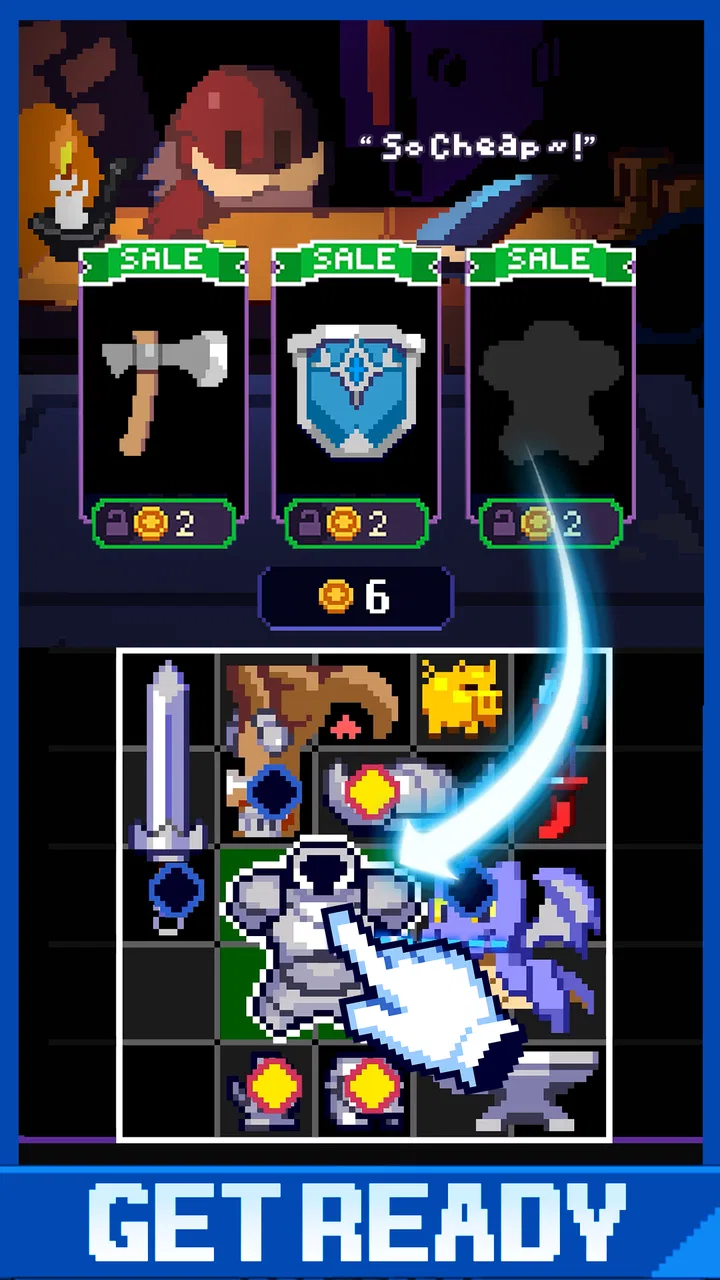
I spent time with Overgeared Hero: Merge RPG as a compact strategy game built around a simple but surprisingly demanding loop: collect equipment, combine matching pieces, improve a hero, and let that hero face enemies automatically. It is free to start, easy to understand, and much more about making good preparation choices than tapping rapidly during a fight.
That distinction matters. This is not a traditional action RPG where I control every attack, dodge, or spell. The interesting decisions happen before and between battles. I decide which gear is worth merging, how much space to give different items, and when a stronger-looking piece is actually less useful than a carefully arranged loadout. The pixel presentation keeps the experience light, while the roguelike structure gives each run a sense of uncertainty.
Developed by 5minlab Corp., the game sits in the strategy category and has attracted a 4.5 average from around 18 thousand ratings, with more than 500 thousand installs. Those figures suggest a healthy audience, but they do not replace personal fit: players who enjoy optimizing a small inventory will probably get more from it than people looking for a story-heavy role-playing game or direct combat controls.
You May Also Like

 Blood Strike: 2.5 Anniversary
Blood Strike’s Loadouts Turn Every Drop Into a Tactical Gamble
A close look at Blood Strike’s custom loadouts: how fast access to signature weapons reshapes its battle royale rhythm, rewards preparation, and narrows the gap between fights.

 Pandora - Music & Podcasts
Pandora’s Music Is Easy to Start, but Harder to Recover
Pandora’s strength is its low-effort path from a seed to a station. Its weak spot is how much confidence it asks you to place in connection, setup, and quiet recovery.

 8 Ball Pool
 Is Built on Rivalries, Rematches, and Routine
A close look at the rivalries, rematches, shared routines, and unanswered safety questions that turn a quick pool match into a persistent mobile community.

 Samsung Music
’s Quiet Strength Is Playing What You Already Own
Its reach comes less from spectacle than from dependable access to a personal library. That simplicity is both the app’s strongest retention engine and its ceiling.

 AccuWeather: Weather Radar
AccuWeather Review: A Quick, Clear Forecast for Everyday Decisions
For everyday plans, the best forecast is the one you can understand quickly. AccuWeather makes rain timing, radar, and local conditions easy to act on, with a few trade-offs.

 Hill Climb Racing
Why Hill Climb Racing Still Turns Crashes Into One More Run
A tiny car, a bumpy hill and one more upgrade: Hill Climb Racing keeps resurfacing because its simple chaos makes every near-miss feel personal.
More From Our News Desk
View All News


How the basic loop feels after the first few runs
The opening minutes are deliberately approachable. A new piece of equipment is easy to understand, merging gives an immediate sense of progress, and auto-battles remove the pressure of learning a complicated control scheme. I could focus on the relationship between preparation and outcome instead of worrying about timing every attack.
The useful habit is to treat each run as two separate jobs. The first job is survival: equip enough useful gear to keep advancing. The second is improvement: reserve room for combinations that may create a better item later. If I filled every available space with the first upgrade I saw, I often gained short-term power while making the next decision awkward. Leaving a little flexibility was usually more valuable than chasing a single impressive item.
That is one of the game’s less obvious lessons. A backpack is not just a storage area; it is the center of the strategy. Every item competes for room with future possibilities. I found myself asking whether a piece helped immediately, supported a merge, or merely blocked a better arrangement. This makes the title feel closer to a small tactical puzzle wrapped around an RPG than to a conventional equipment screen.
Auto-battling also changes how I judge upgrades. A piece that looks exciting in isolation may not solve the weakness that caused a defeat. If the hero repeatedly struggles during longer encounters, adding another general improvement may be less useful than building a more coherent collection of gear. I learned to look at the pattern of failure rather than reacting to the last item that appeared.
The roguelike element gives this process variety. Runs do not feel like a perfectly fixed checklist because the available equipment and choices can push me toward different builds. That unpredictability is enjoyable when I accept that not every attempt will produce an ideal hero. It can be frustrating when I want a precise result, but the tension is part of the reason the loop remains interesting after the tutorial phase.
A practical routine for short play sessions
For an everyday situation, imagine having a few minutes during a commute or while waiting for an appointment. I would start by checking the current backpack rather than immediately spending every reward. I would merge only when the result clearly improved the active setup or opened useful space, then begin the next battle and review the outcome afterward. This makes the game comfortable for brief sessions because the meaningful thinking happens in small bursts.
When I had more time, I used the same routine more deliberately. I reviewed which items had been occupying space without contributing, identified the hero’s most obvious weakness, and avoided making several unrelated changes at once. Changing one part of the setup at a time made it easier to understand why a run improved or collapsed.
That approach is especially helpful for new players because the automatic fights can otherwise make losses feel mysterious. The game does not ask for fast reflexes, but it does reward paying attention to cause and effect. If I changed everything after every defeat, I learned very little. If I made one meaningful adjustment and watched the next result, the system became easier to read.
Settings and controls worth checking early
The first thing I recommend is checking the available settings before settling into long sessions. In an auto-battle game, small presentation choices can affect comfort more than they would in an action title. I prefer a setup that lets me see rewards and equipment clearly without making the screen feel visually crowded, especially when several items appear close together.
I also treat any sound and notification controls as part of the routine. If I am playing in a public place, I want the game to fit quietly into the background rather than interrupting whatever I am doing. At home, sound can make rewards feel more satisfying, but it is not necessary for understanding the strategy. Adjusting those options early prevents the game from becoming annoying during otherwise convenient short sessions.
Another useful check is the way the game handles repeated actions and transitions. Since the core loop includes automatic battles and recurring equipment decisions, I pay attention to whether I can move through familiar screens without unnecessary hesitation. I do not expect every step to be instant, but a comfortable rhythm matters when the game is designed around many small choices.
I would also confirm that the current version is suitable for the device before committing to it as a regular game. The listed current version is 1.31.7, and the minimum operating system is Android 7.0. It is available at no upfront cost, although optional in-app purchases range from $0.49 to $94.99 per item. That combination makes it approachable for experimentation, but I would still keep spending separate from ordinary progression decisions.
My strongest settings-related advice is not to use convenience as a substitute for understanding. If an option makes collecting or moving through the game faster, that is useful, but I would still pause long enough to inspect what has changed in the backpack. Skipping every transition may save time while also hiding the reason a build is working. Experienced play is not simply faster; it is faster without losing the information needed for the next decision.
Faster patterns that preserve good decisions
The quickest improvement I found was to establish a fixed inspection order. I looked first at the hero’s active equipment, then at possible merges, then at empty or awkward spaces, and only after that at newly offered items. This prevented me from being distracted by a shiny reward before understanding what the current setup actually needed.
A second habit was to group decisions by purpose. If I was trying to increase immediate strength, I made that the priority for the next few choices. If I was trying to create room or prepare a merge, I avoided spending that space on unrelated objects. Mixing both goals constantly made the backpack harder to read and caused me to lose track of the run’s direction.
There is also a useful trade-off between a clean inventory and a powerful inventory. A tidy arrangement feels satisfying, but the strongest arrangement is not always the neatest one. Sometimes a temporary cluster of items is worth keeping because it supports a likely combination. Other times, holding onto a theoretical future merge weakens the hero right now. I became more consistent when I treated space as a resource with an immediate cost, not as a free promise of later power.
For repeat attempts, I recommend remembering decisions rather than memorizing a single build. The available path can change, so copying one arrangement exactly is less reliable than remembering why it worked. Was the setup strong because it solved a defensive problem, because it used space efficiently, or because the run happened to offer compatible equipment? That distinction helps prevent false confidence after one successful attempt.
Another advanced but practical habit is to stop upgrading on autopilot after a good result. Success can tempt me to repeat the same choice without checking the new situation. However, a later encounter may expose a different weakness, and a merge that was excellent earlier may now consume space needed for a more urgent improvement. The game rewards consistency, but not blind repetition.
I also found it useful to separate “interesting” from “necessary.” A novel item or unusual combination can make a run memorable, but it is not automatically the correct choice. When I was close to losing, I favored the option that addressed the immediate problem. When the run was stable, I had more freedom to test a less obvious arrangement. That simple distinction made experimentation feel safer.
Where the strategy becomes more demanding
The game’s accessible controls hide a real limitation: auto-battles reduce direct control over mistakes. I cannot rescue a poorly prepared hero with a perfectly timed dodge or a clever attack sequence. Once the fight begins, the result is largely a judgment on the choices made beforehand. Players who want moment-to-moment agency may find this passive compared with an action RPG.
The same structure can also make progress feel repetitive if the equipment decisions stop presenting meaningful tension. The appeal depends on whether I still care about improving the arrangement, testing a different direction, or making the next run cleaner than the last. If I only want a constant stream of new story scenes or highly varied combat, this is probably not the right choice.
There is a second limit in the merge concept itself. Combining items feels rewarding, but it can encourage hoarding. I sometimes kept pieces for too long because they might become useful in a later combination. That behavior created clutter and weakened immediate performance. The correct answer is not to merge everything or save everything; it is to set a clear reason for holding an item and release it when that reason disappears.
The free entry point is helpful, yet the presence of optional purchases means I would approach the economy carefully. I would play long enough to decide whether the backpack strategy is genuinely enjoyable before spending anything. Purchases may be attractive when I want convenience or faster experimentation, but they should not replace learning how the equipment loop works. A player who dislikes the core decisions will not be rescued by additional spending.
The age rating is Everyone, which fits the straightforward presentation and approachable premise. That does not mean every player will enjoy it equally. Younger or casual players may appreciate the simple controls, while experienced strategy fans may want deeper control over battles than this format provides. The rating describes accessibility, not complexity or long-term fit.
Who should choose it, and who should look elsewhere
I would recommend this game to someone who likes inventory puzzles, incremental character building, and runs that can be improved through better preparation. It works particularly well for players who enjoy asking, “What should I keep, and what should I sacrifice?” The automatic combat makes it suitable for relaxed play, while the limited space gives experienced users enough friction to think carefully.
It is also a good match for people who want a strategy game that can be checked in short sessions. I could make a meaningful decision without needing a long uninterrupted campaign. The pixel art supports that relaxed tone, and the roguelike structure gives each attempt a reason to feel different even when the basic routine remains familiar.
I would skip it if your priority is direct combat mastery. Games with manual movement, active abilities, or precise timing will offer more control and a stronger sense that your hands determine each victory. I would also look elsewhere if you want a large world, extensive dialogue, or a role-playing experience centered on story rather than equipment management.
Compared with typical merge games, this one gives the combining mechanic a clearer strategic consequence because the result feeds into a hero and automatic battles. Compared with standard idle RPGs, it asks for more attention to arrangement and choice instead of simply collecting rewards. Compared with action roguelikes, it removes reflex-based combat and places the challenge in preparation. That middle position is its main identity, but also its main boundary.
My verdict after settling into the routine
The best way to play Overgeared Hero: Merge RPG is to treat every backpack decision as a trade-off, not as a race toward the biggest visible item. Once I adopted that mindset, the game became more satisfying. I stopped judging runs only by whether the hero won the next battle and started judging them by whether my choices left a sensible path forward.
5minlab Corp. has built a strategy game that is easy to pick up but not entirely mindless. The pixel roguelike format, merge-focused equipment loop, and auto-battles work well together when I want a low-pressure game with small decisions. Its strongest moments come from turning limited space into a plan, then seeing that plan survive a difficult encounter.
Its weaknesses are equally clear. Combat can feel passive, repeated runs may lose their appeal for players who need constant novelty, and the temptation to hoard or spend can distract from the actual strategy. I also would not recommend it to anyone expecting a conventional RPG with extensive exploration or hands-on fighting.
Still, as a free strategy game for Android users on Android 7.0 or later, it is easy to try without a large commitment. The Everyone rating makes the presentation broadly approachable, and the current version keeps the experience clearly defined around its central loop. My advice is to play patiently, check the settings for comfortable short sessions, keep a deliberate inspection order, and only spend money after deciding that the merge-and-backpack puzzle is genuinely fun for you.
For me, that is enough to make it worth recommending to a friend who enjoys optimization in small doses. It is not a universal RPG, and it does not pretend to be one. It is a focused strategy game about building a stronger hero from imperfect choices, and it works best when I enjoy the thinking between battles as much as the victories themselves.
FAQs for Overgeared Hero: Merge RPG
01What is the main gameplay of Overgeared Hero: Merge RPG?
Overgeared Hero: Merge RPG is a unique blend of role-playing and merging mechanics. Players collect and merge items to upgrade their hero, embarking on quests to defeat enemies and bosses. The game emphasizes strategic merging to improve gear and abilities, providing a fresh twist on traditional RPG elements.
02Is Overgeared Hero: Merge RPG free to play?
Yes, Overgeared Hero: Merge RPG is free to download and play on both Android and iOS platforms. However, it includes in-app purchases that allow players to buy items, currency, or other enhancements. These purchases can accelerate progress or provide cosmetic upgrades, though they are not necessary to enjoy the game.
03What are the system requirements for Overgeared Hero: Merge RPG?
To run Overgeared Hero: Merge RPG smoothly, Android users should have a device with at least Android 5.0 and 2GB of RAM. iOS users need a device running iOS 11.0 or later. Ensuring sufficient storage space and keeping the app updated will also help in maintaining optimal performance.
04Does Overgeared Hero: Merge RPG require an internet connection?
While Overgeared Hero: Merge RPG can be played offline, certain features like updates, in-app purchases, and leaderboards require an internet connection. Connecting to the internet occasionally can enhance the gameplay experience by allowing access to these additional features and keeping the game updated.
05How does the merging mechanic work in Overgeared Hero: Merge RPG?
In Overgeared Hero: Merge RPG, players merge items of the same type and level to create more powerful gear. This mechanic encourages strategic planning as players decide which items to merge for optimal hero upgrades. The merging system is intuitive, making it accessible for both new and seasoned players.
Pros
- Engaging storyline with immersive quests.
- Beautifully crafted graphics and animations.
- Intuitive controls enhance gameplay experience.
- Regular updates with new content and features.
- Challenging levels that keep players hooked.
Cons
- Requires constant internet connection.
- In-app purchases can be quite pricey.
- Occasional lag on older devices.
- Energy system limits extended play sessions.
- Some features locked behind paywalls.

Overgeared Hero: Merge RPG
Gallery